
Total Recall
One of the great strengths of science fiction is its ability to combine the intellectual and philosophical aspects of the genre with completely fun, absurd, and escapist stories. But is it possible for a film to be at the two extremes of the same ideas – to be extremely absurd and intelligent, yet still be intelligent because it is extremely absurd, and to be so both that it remains one of the greatest mysteries of cinema for over 30 years? For me, there is one film that fits this profile perfectly:
The Masterpiece of Sci-Fi: “Total Recall”
Released in 1990, directed by Paul Verhoeven and starring megastar Arnold Schwarzenegger, Total Recall, is one of those films that the more time passes, the more you think about it and the more fascinating it becomes. The film is a perfect combination of all the exaggerations and absurdities of the action films of the 80s with all the philosophical depth of the works of Philip K. Dick, questioning our reality, our perception of memory, and challenging even your perception as an audience, not only about the film itself but also about our own reality.
Mixing this with a touch of Paul Verhoeven’s ideas that came from RoboCop, talking about corporate authoritarianism, lack of empathy, the search for freedom, and of course, the money of cinema, a true relic of the 90s, no matter how many times you’ve already watched it, it’s a film that always has something to offer the audience, and its ending remains open to this day – was it all real or was it all a dream?
From Short Story to Sci-Fi Masterpiece

Although the “Arnoldistic” version of Total Recall is famous, the story of Total Recall has been known in science fiction since 1966 when Philip K. Dick, one of the most influential authors of the genre, published a short story in Fantasy & Science Fiction named We Can Remember It for You Wholesale. The short story is considerably different from the film and much shorter.
In the short story, we follow Douglas Quail, an office worker who dreams of visiting Mars, something that is quite annoying for his wife, who cannot stand these dreams and seems not to like much of this unspecified future. Only those who have permission from the Interplan, an authoritarian government intelligence organization, can go to Mars. Quail’s only option is to go to Recall to implant the memory that he was an agent and actually went to Mars. But when they try to implant the memory, they discover that Quail was actually an agent and had been to Mars, and now both Recall and Quail have to deal with this discovery.
Unlike the film and its many action scenes, the short story is much calmer. Quail is not involved in any shootouts, but most of the story is him communicating mentally with the agents to try to find a way to get out of that situation, since he no longer wanted the confusion that the memories brought, but at the same time, he did not want to be killed by the agency.
The short story is not an action story, it is actually a psychological plot with a light tone that talks about the essence of our memory. Are we really who we are? If you are sure that you have done something and have memories of it, what would convince you that this is not true? How would you know that what you believe is the truth?
The ending of the short story is quite interesting, so I don’t want to give any spoilers, as that would ruin the experience. You can find this short story in the excellent “Adapted Realities”, a collection of stories that ended up on the big screen.
The Arduous Journey to the Big Screen
The original story was so short that when it came time to turn it into a film, a problem arose – the entire story would only be enough to adapt into a 20-minute short film. Deke Heyward and Ronald Shusett, who were the first to work on the adaptation, added many things to achieve the necessary length, but this film was stuck in pre-production for a long time, which means it was reworked many times.
While it was with producer Dino De Laurentiis’ production company, the script was reworked about 40 times. Even David Cronenberg, who was attached to the project as director, ended up leaving due to the many disagreements with the producers. But it was still easy to see how some of Cronenberg’s ideas were still there.
Arnold Schwarzenegger’s Vision Brings “Total Recall” to Life
The idea only came off the paper thanks to Arnold Schwarzenegger, who saw the potential of the story and convinced Carolco Pictures to buy the script and hire Paul Verhoeven. Verhoeven’s involvement is precisely what made Total Recall a brilliant work.
With Verhoeven and Schwarzenegger on board, the company hired Gary Goldman, who, along with Ronald Shusett and with direct participation from Verhoeven, created the final version of the story that we know today. The investment in the film was heavy, with it being one of the most expensive films of the time, which ensured an impressive production, from the environments to the special effects.
But what really makes Total Recall unforgettable in science fiction is its story and, above all, the way it is structured – a structure that ends up making this film practically unique, a film that exists in two realities, two interpretations that change not only the ending but the entire tone of the film. And incredibly, both are correct.
The Genius of “Total Recall”: Two Realities, One Film
I warn you that we will have spoilers from the film. However, these spoilers do not ruin the experience so much, as the film itself tells everything that will happen in the first 15 minutes. It is a film that becomes much more interesting when you already know what is going to happen and start to pay attention to all the details that are deliberately placed in its plot.
The film tells the story of Douglas Quaid, and unlike its literary counterpart, he is not an office worker, an ordinary man, but a manual laborer with a dream of going to Mars. But he can’t afford the trip, and his wife is always trying to convince him to stay on Earth and seek other destinations. This leads him to seek Recall, a company that can implant the memory that he really went to Mars and satisfy his desire to visit the red planet.
But as any good salesman, the Recall representative, Vilos Cohaagen, also convinces Quaid to buy a package of “ego trip” where Quaid would also remember being a secret agent on an important mission that would make him a great hero in a thrilling adventure full of action, pursuit, beautiful women, terrible villains, and a triumphant ending.
This part of Total Recall is also quite interesting in its meta-language – what Recall is selling to Quaid is not very different from what the film industry sells to us, the audience – the possibility of living an escapist adventure to help us escape our reality.
The problem begins when they discover that the mind is more problematic than it seems – Quaid had already gone to Mars and, worst of all, he was really a secret agent. This complicated things not only for him but also for the company. After the confusion, they decide to erase Quaid’s memory of his visit to Recall, but his mind is still confused, and soon people he trusted begin to pursue him.
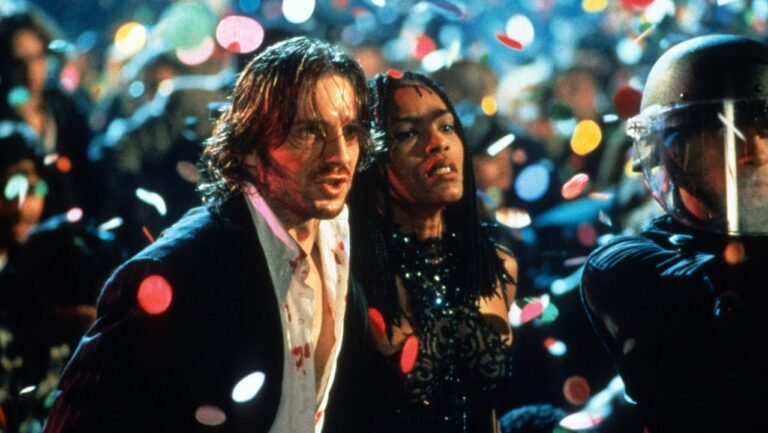
But even without memory, Quaid now possesses a natural talent to defend himself and, of course, to take down anyone in his path, including his own wife when he tells her what is happening. It seems that his entire life, his existence as Quaid, is a lie, and all those who are part of this lie are implanted by the villain Cohaagen to ensure that the farce is complete.
The protagonist only begins to have an idea of what is happening after his old identity, Hauser, contacts him with a clear message: exploiting the workers on Mars while enriching themselves out of greed, the radiation filters in the poorer sectors are defective, leading to the creation of mutants with powers of clairvoyance and mind reading. This scenario also creates rebels led by Kuato, a group of Martians trying to overthrow Cohaagen’s regime.
Quaid/Hauser needs to join the rebellion and knows of a great secret that can bring down the entire regime – there is something inside the Pyramid of the Turbinium mining operation that can end the tyranny that dominates the planet. Quaid needs Kuato to unlock his memories, and together with Melina, literally the woman of his dreams, he will lead the rebellion to victory.
But Quaid is betrayed and discovers that Hauser was actually a double agent for Cohaagen. However, Quaid finds his true willpower before having his personality erased and manages to escape, going to the Pyramid, an alien artifact created by ancient beings capable of giving Mars an atmosphere and air for everyone. In this way, he defeats Cohaagen, who has one of the most agonizing deaths in cinema, and ends up with the girl of his dreams under the now blue sky of Mars.
The Genius of “Total Recall”: Two Realities, One Film
This is a film structured like most films of the 80s and 90s, with its escapist content providing it with absurd moments full of great coincidences and impossible attitudes, giving an invincible protagonism to Quaid. But in this case, all these clichés are intentional. While we see Quaid’s entire saga on Mars and his incredible adventure, something remains in the viewer’s mind the entire time – a doubt that is the essence and the most interesting part of this film.
Yes, if we stop to notice, everything that happens in the film is exactly what Vilos Cohaagen said would happen in Quaid’s fantasy. When confronted with the possibility that he is in a dream, when his supposed wife and a Recall doctor warn him that he is having a psychotic episode and is at risk of being lobotomized on Earth, he again explains everything that will happen until the end of the film.
The woman Quaid falls in love with, Melina, even appears on the Recall monitors when Quaid is under anesthesia.
The alien reactor that saves everyone on Mars appears during the programming of his false memory.
All the coincidences, the Herculean acts of the character – each part that forces our suspension of disbelief is explained by the fact that we are seeing a fantasy, a dream, an implanted memory.
The film ends with a white flash instead of a standard fade to black because we are seeing Quaid wake up after being lobotomized, directly confronted with reality to escape his illusion. His fantasy literally breaks through the wall, putting him back in his dreams, with the clue in reality that he prefers and that is not really true – everything is fabricated to be the perfect experience.
But many times, the perfect experience takes us dangerously away from reality, making us slaves to our own fantasy. In fact, it is a tragic film, the opposite of the escapist work it is on the surface. But believe me, the layers go even deeper, because if you are 100% sure that Total Recall is reality, you are wrong. But if you are 100% sure that Total Recall was a dream, you are also wrong.
Total Recall is fascinating because it has two completely different interpretations, two tones, two realities, and there is no exact answer as to which is the true one. Of course, everything that happened in the film is said by a Recall employee before it happens, which proves it is a dream. But both the rebellion on Mars and other details we see in the film are presented to Quaid before he goes to the company, as news that is already playing on TV and he is already dreaming of Melina before she appears on the Recall monitor.
This proves that it is reality. Of course, the way his wife convinces him not to go to Mars and acts strangely at the beginning of the film, and his co-worker not wanting him to go to Recall, prove that everything was real – they were infiltrated agents. But she could just be jealous of the brunette Quaid dreamed of every night, and his co-worker could be worried that he knew the Recall procedure was very dangerous.
The supposed doctor who appears on Mars and that Quaid realizes is lying because he is sweating proves that the dream story is nothing more than a Cohaagen agent trying to deceive Quaid. But the doctor really works for Recall, as he appears before these events. Everything can be just the protagonist’s mind creating something that does not move away from his sweet fantasy – was it a dream, was it reality? How to know the truth?
The idea is to keep the mystery, keep the audience intrigued, and that is what this film has done for the last 30 years and will continue to do for the next. Without this, it is a unique brilliance that Verhoeven, Goldman, and Bennon managed to bring to a story that could have been just more of the same, but is one of the definitive masterpieces of the last decades in cinema.
A Masterpiece That Challenges Our Perception of Reality
It is a story that at the same time is just a 90s action movie and one of the most intelligent films that subverts these tropes. Regardless of how you look at it, you are right and wrong at the same time, as the film constantly challenges our perception of what is real or not.
But more importantly, it reminds us that we are totally dependent on how our mind frames what is real or not. If you are convinced that the whole story is a dream, there is nothing that will convince you that it is reality, and vice versa. The film was meticulously designed for this, to show us how much our mind makes reality what we want it to be.
A film that exists in two realities at the same time – if that’s not genius, I don’t know what is. And there’s an angle that’s quite interesting to explore in this story: Verhoeven is a master at criticizing the excesses of cinema. He does this in relation to the escapism of cinema, but also by transforming his discussion of reality into an important message for society.
As I compared, what Recall sells is very similar to a film, only more immersive – the possibility of living different adventures just through our passive memory. This principle is where Quaid finds himself, in a position where the escapism of his mental film has surpassed his will to see reality, and whenever reality confronts him, the fantasy emerges again.
Total Recall is one of the few films that constantly challenge the viewer. The audience wants the story to be real, wants Quaid to have been a great hero – it’s the standard expectation we have for these narratives. And while it’s not wrong to believe that everything was real, it purposefully leaves everything ambiguous so that even in our certainty there is doubt.
But when the viewer reaches the same point as Quaid, of abandoning all doubt to trust 100% in the possibility of the escapism reality, Total Recall becomes a problem. It is a completely 80s/90s film with the same tropes, but in the end, it also asks us to remember that these films are just films, nothing of this is real – ignoring all the signs that the reality is another, more complex, more profound.
There are many who, like the protagonist, live in the perfect reality that is fabricated by our mind, and the nostalgic idea that permeates the minds of many today, especially with the view that everything was perfect in the past and that we lived in an idyllic reality, makes the film’s theme quite necessary. Total Recall asks us to question reality, especially the one that seems perfect.
In this context, Verhoeven also related this theme of the film to ideological issues. We can believe in the reality that is shoved into our heads, just as Quaid does, but Verhoeven invites the viewer to question this. But this is not to question the reality that you disagree with – that’s easy, anyone can disagree with what they don’t like. It’s like those who believe the film is a dream, disagreeing with the idea that everything is real. You’ll have all the evidence to defend your side.
About the Author





1 thought on “Total Recall Review: Sci Fi Classic of Reality and Illusion”